
In a 2017 report by the International Union for Conservation of Nature (IUCN), it stated that 35% of all micro fabrics in the ocean come from laundering textiles. These textiles are made from clothing that is cheap and tears easily in the wash prompting consumers to quickly dispose of the items and replenish their wardrobes. This is a viscous cycle that is slowly destroying the waterways. Cities like Austin have yet to suffer the same fate as cities in developing nations. The Ganges River in India is the sixth most polluted river in the world, providing water to 40% of India’s population, roughly 500 million people. Many industries have set up shop along the river and use it as a dumping ground. Trash, chemical waste, human waste clutter the banks, causing eyesores and disease. The Ganges also plays a vital role in the Hindu religion, during religious ceremonies roughly 70 million people bathe in the river, adding to the pollution but also getting sick from the chemical waste, a study conducted by the National Cancer Registry Program (NCRP) under the Indian Council of Medical Research in 2012, suggested that “those living along its banks in Uttar Pradesh, Bihar and Bengal are more prone to cancer than anywhere else in the country” (https://www.icmr.nic.in/).
If something is not done to protect the environment from fast fashion companies, Townlake, the jewel of Austin will look like the Ganges in a matter of years. Last year when the rain caused the dams to back up and overflow the Colorado River, the river that runs through Austin, turned brown from soot and debris, then in the summer a bacteria began killing. Its easy to think we have an abundance of water, and “about 71 percent of the Earth’s surface is water-covered, and the oceans hold about 96.5 percent of all Earth’s water” (https://www.usgs.gov/special-topic/water-science-school/science/how-much-water-there-earth?qt-science_center_objects=0#qt-science_center_objects). That means that only 3.5 percent of the water on Earth is drinkable. The fashion industry is responsible for consuming 79 billion cubic meters of water in 2015, the equivalent of 32 million Olympic swimming pools. It is expected that by 2030 this will rise by 50 percent (https://www.refinery29.com/en-us/water-consumption-fashion-industry). Can you imagine, 64 million Olympic swimming pools full just to make the clothing we wear each year. That number is almost impossible to comprehend. A smaller more manageable number would be 2,720 liters, which is the amount of water needed to make one t-shirt. That is also the amount of water the average person consumes in a three year period. Next time you are at the store looking at the sale rack think about how each shirt you buy used three years of your drinking water (https://www.refinery29.com/en-us/water-consumption-fashion-industry). When put like that it’s a lot easier to put down that t shirt and make something in your closet work for a little bit longer.
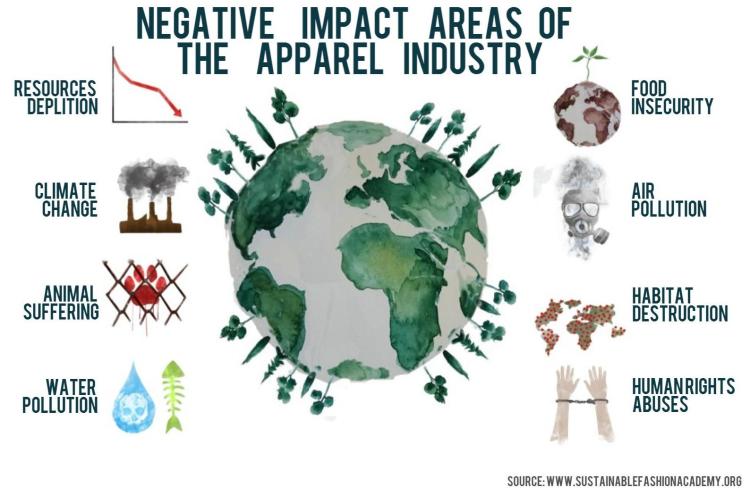

 Dying To Wear